
Project HAPPIEST
H-A-P-P-I-E-S-T
Health, Air Pollution and Population Initiative in Education and Science Training
About the program
Health, Air Pollution and Population Initiative in Education and Science Training (HAPPIEST) R25 was established at the University of Utah (UU) in 2021 to address pressing challenges related to air pollution and health. This is because air pollution negatively affects the majority of the US population. It causes respiratory illnesses, neurological and mental health problems, and reproductive ailments. Air pollution is particularly acute in Utah’s Salt Lake Valley, where the University of Utah is located. The area’s topography produces temperature inversions in the winter, leading to stagnant conditions and poor air quality with well-documented human health effects. Between 2021-2025, the program trained undergraduate students from underrepresented backgrounds in air pollution-related health research. As of Summer 2026, HAPPIEST is open to all students no matter their background and the focus broadened from “air pollution and health” to “climate and health”. This is because key drivers of ongoing changes in climatic patterns—including increased temperatures, precipitation extremes, extreme weather events and disasters, sea level rise, and changing growing seasons and habitat ranges—influence a broad spectrum of health outcomes. This occurs directly through events such as extreme heat, droughts, wildfires, storm surges, and floods and indirectly through various exposure pathways, such as declining air, water and food quality/quantity; increasing infectious diseases, vector transmissions, and allergen exposures; population displacements; health care interruptions; infrastructure and supply chain disruptions; and more prevalent economic insecurity.
View Publications, Presentations, & the Program Evaluation
HAPPIEST 2027 will take place May 17, 2027-July 29, 2027
The HAPPIEST experience
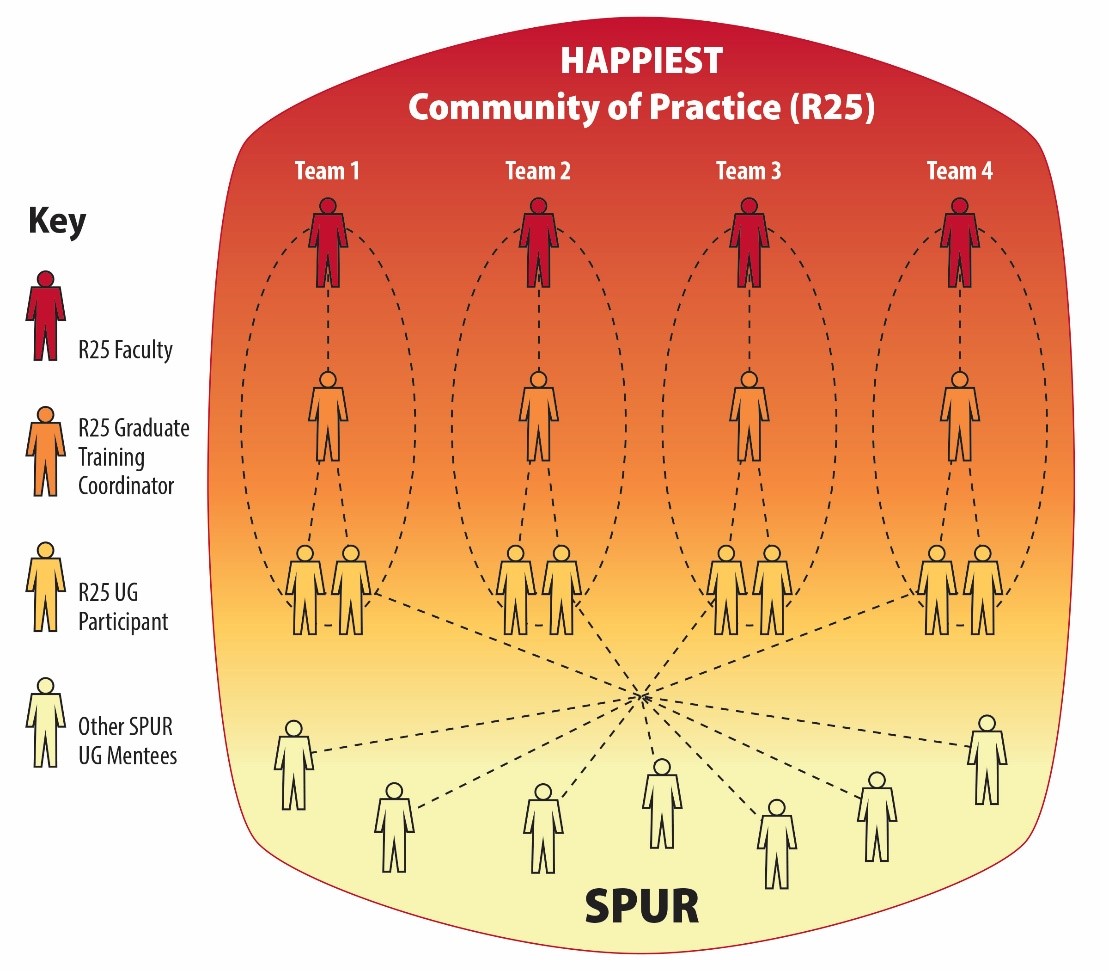
HAPPIEST is structured by a mentoring “community of practice,” which supports an evidence-based ten-week summer training program for undergraduate students in the area of environmental health science. This community includes four teams, each comprised of two undergraduate students, one graduate student training coordinator, and one faculty mentor. Teams work on locally relevant air pollution and health research projects, with the potential for interdisciplinary integration across teams. Eight undergraduate students are funded each summer. The program leverages a unique partnership with the UOU’s successful Summer Program for Undergraduate Research. The program prepares students for placement into competitive graduate programs in the environmental health sciences. HAPPIEST also fuels interdisciplinary collaborations among faculty mentors with the goal of informing novel solutions to environmental health problems in the Salt Lake Valley and beyond.
Selected students receive a stipend of $5,000 (less applicable taxes) over the course of the program. Up to 4 students each summer also receive on-campus housing.
Students become part of the community of practice. They conduct their research alongside another HAPPIEST trainee. The two undergraduate work closely with a HAPPIEST-funded graduate student training coordinator, and a faculty mentor. They work ~35 hours/week on their research tasks. They also attend SPUR programming and several HAPPIEST professional development workshops that are specific to environmental health.
Each student may receive financial support to present their research at a regional or national meeting in the year after their summer research experience. Faculty mentors and graduate student training coordinators mentor the student through the process of presenting at a conference.
Apply to HAPPIEST
HAPPIEST 2027 will take place May 17, 2027-July 29, 2027
Previous Cohorts
Project Directors
Sara Grineski
Dr. Grineski is an active researcher in the area of environmental health; furthermore,
she is an experienced director of undergraduate research training programs. She is
also the director of undergraduate studies in Sociology at UOU and co-director of
the UOU’s Center for Natural and Technological Hazards (with HAPPIEST Co-Director
Collins)and co-director of the Wilkes Scholars Program. Grineski’s environmental health
research has been supported by the National Institute of Minority Health and Health
Disparities with an award towards the Center of Excellence in Environmental Health
Disparities, which she directed at the University of Texas at El Paso (UTEP), as well
as by the National Science Foundation and the Environmental Protection Agency. Grineski
gained experience in managing undergraduate research training programs while at UTEP.
She was a PI on a multiple-PI team for the Building Infrastructure Leading to Diversity
(BUILD) initiative site at UTEP supported by the NIH Common Fund. As a director of
UTEP’s BUILDing SCHOLARS Research Enrichment Core, which had a budget of $5 million
in direct costs, she oversaw a summer research program for 70 undergraduate students
from regional two- and four-year universities, whom the program matched with faculty
research mentors at 13 different research partner institutions; she also managed a
mentoring program for ~50 undergraduate UTEP students working on research with faculty
during the academic year, and a peer-mentoring program for undergraduate UTEP students.
Tim Collins

Dr. Collins is an established researcher in the areas of air pollution, environmental
inequalities, and health disparities. He is also the director of undergraduate studies
in Geography at UOU. His research on environmental health has been funded by the National
Institute of Minority Health and Health Disparities, National Science Foundation,
Environmental Protection Agency, and National Aeronautics and Space Administration.
While at UTEP, Collins gained experience in the scientific and administrative leadership
of undergraduate research training programs both in his role as a Provost’s Faculty
Fellow with the Campus Office of Undergraduate Research Initiatives and as a PI on
a multi-PI team for BUILDing SCHOLARS, which is one of ten sites in the NIH-funded
BUILD initiative. As director of the Institutional Development Core, which had a budget
of $4.5 million in direct costs, he oversaw the development of a novel research-driven
curricular program (including new course-based undergraduate research experiences),
searches for key personnel (multiple new tenure-track faculty members and postdoctoral
personnel) to support the program, improvements to biomedical research training environments
across campus, small grant programs for faculty, and a mentoring awards program.
About the Faculty Mentors
HAPPIEST includes a pool of faculty mentors from:
- the physical sciences
- engineering (e.g., atmospheric science, chemical engineering, environmental engineering, exposure science)
- the biomedical sciences (e.g., neurology, pulmonology, psychiatry)
- the socio-behavioral sciences (e.g., sociology, geography, demography, political science)
thereby fostering the development of transdisciplinary perspectives among student
participants as well as collaborations across faculty-led research teams. Each year,
students have the opportunity to work with some of these faculty.
|
Name |
Department and Climate-Health Topical Focus |
|
Adrienne Cachelin |
School of Environment, Society and Sustainability (ESS); Impacts of changing climate on urban agricultural production and farmer livelihoods |
|
Alessandro Rigolon*** |
City and Metropolitan Planning (CMP); Green space provision and its uneven effects on health and climate adaptation |
|
Alexandra Ponette-González*** |
CMP; Personal exposure to air pollution and heat in cities |
|
Amanda Bakian*** |
Psychiatry; Individual, additive, and synergistic effects of multiple, climate-related environmental exposures on the risk of psychiatric outcomes |
|
Andrew Linke |
ESS; Impact ofunpredictable weather on agriculture and livelihood losses and then health |
|
Andy Hong*** |
CMP; Urban heat islands and heat-related health effects among older adults |
|
Bill Anderegg |
Biological Sciences; Climate impacts on wildfire smoke, pollen trends, and respiratory health |
|
Daniel Leung |
Infectious Diseases; Impact of pollution and climate on intestinal infections and respiratory tract immunity |
|
David Curtis*** |
Family and Consumer Studies; Influence of climatic and local environmental attributes on population health outcomes |
|
Derek Mallia*** |
Atmospheric Sciences; How changing climate will impact air quality in the future |
|
Fernando Wilson |
Population Health Sciences; Effects of adverse air quality on health outcomes and healthcare utilization and costs across historically marginalized communities |
|
Gannet Hallar |
Atmospheric Sciences; Understanding the precursors to air quality and most effective emission strategies to improve air quality |
|
Heather Holmes*** |
Chemical Engineering; Increasing amount of wildfire smoke and extreme heat events and the associated impacts on human health |
|
Hilary Coon |
Psychiatry; How genetic and environmental risks (including climate) lead to complex psychiatric conditions |
|
Jeff Robison |
Pediatrics; Impact of climate shifts on children |
|
Jeff Rose*** |
Parks, Recreation, and Tourism; Impacts of climate extremes on people experiencing unsheltered homelessness |
|
Jennifer Shah |
ESS; Climateanxiety among undergraduate students |
|
Joemy Ramsay |
Urology and Surgery; Howchanges in climate leading to extreme weather patterns (e.g., wildfires) impact cancer patients and survivors |
|
Katharine Walter |
Internal Medicine; The impact of rapid climate shifts and land use change on the distribution of pathogenic fungi, like the Valley fever fungus |
|
Kerry Kelly*** |
Chemical Engineering; Helping individuals make data-driven decisions to protect their health from air quality hazards, such as wildfire smoke and dust events |
|
Lazarus Adua |
Sociology; Human dimensions of energy, structural drivers and consequences of global environmental change, and local governments’ policies |
|
Matthew Fry |
ESS; Strategies used in urban public and private spaces for climate resiliency and barriers to accessing those spaces during extreme events |
|
Monika Lohani*** |
Psychology; Influence of the changing climate on emotional well-being and health throughout the lifespan |
|
Nancy Daher |
Occupational and Environmental Health; Air quality disparities, indoor air quality in schools, wildfire smoke toxicity, inequitable impacts on vulnerable communities |
|
Naomi Riches |
Occupational and Environmental Health; Air quality and the impact on adverse pregnancy outcomes, such as stillbirth and pre-eclampsia |
|
Neng Wan*** |
ESS; Inequities in exposure to environmental pollutants and their influence in health disparities |
|
Ramkiran Gouripeddi |
Bioinformatics; Characterizing intermittent, cumulative, and cooperative multi-scale exposure effects on health |
|
Sara Grineski*** |
Sociology; Social disparities in exposure to climate hazards; extreme weather and mental health |
|
Sara Yeo |
Communications; Air quality and its effects on student-athletes’ health; the use of humor for strategic communication about the climate |
|
Sonam Sherpa |
ESS; Detecting patterns of (climate) extreme events and exposure from space |
|
Timothy Collins*** |
ESS; Climate hazards and disasters, exposure disparities, and health inequities |
***denotes mentors who have served as HAPPIEST mentors
Meet the Summer 202 HAPPIEST Faculty Mentors
The faculty mentors are an outstanding group of faculty who are conducting cutting-edge
research on air pollution and health from multiple disciplinary backgrounds. Click
on the links below to read their HAPPIEST project description as posted on the SPUR
webpage and to apply to work on their project.
Available Projects
David Curtis
Who is Sensitive to Exposure to Air Pollution? Physiological and Psychosocial Mechanisms to Cardiovascular and Metabolic Disease
 Project Background
This research project will investigate the relationship between long-term air pollution exposure and cardiometabolic health outcomes, with a focus on differences in sensitivity by age and biological sex. Moreover, we will test physiological and psychosocial mechanisms of the link between air pollution and cardiometabolic health that may account for demographic differences in sensitivity. For this project, students will use longitudinal data from the Midlife in the United States study for more than 7,000 participants, with the follow-up period covering up to twenty-five years (from 1995 to 2019). The MIDUS study leverages an extremely rich set of measures and data collection protocols, and is well-suited for the current project.
Tabitha Benney
Integration of Traditional Ecological Knowledge with STEM Curriculum on the Wind River Reservation
 Project Background
Data from the U.S. Department of Education in 2019, shows that Native American students had the lowest on-time graduation rate in the United States. In 2023, three school districts on the Wind River Reservation in Wyoming, the Native American students experienced both lower graduation and attendance rates than the state average (Shippen, 2023; Maloney, 2023). In addition, previous work has indicated that this issue has been exacerbated by environmental hazards such as air pollution, food insecurity, and energy scarcity. To address this issue, our team has begun a study in Wind River to better understand how to improve educational outcomes, especially in the STEM fields.
Sara Grineski/Tim Collins
Homelessness, Air Quality, and Park Displacement Events
 Project Background
Homelessness presents both social and environmental concerns. People living in tents, tarps, and other rudimentary shelters represent a very visible social justice concern. People experiencing unsheltered homelessness are more likely to suffer from environmental disamenities, primarily through higher daily exposure to poor air quality, poor water quality, and weather-related disasters, among others. This population is also subject to unexpected and traumatic abatements and displacement events. While such events are generally unpredictable, specific public spaces (Pioneer Park and Liberty Park) have regularly scheduled displacement during weekly summer markets.
Jeff Rose
Resident Perspectives on Air Pollution and Environmental Injustice in Salt Lake County
 Project Background
Utah is the fastest growing state in the US, and Salt Lake County (SLCo) is the most densely populated portion of the state. SLCo periodically experiences the worst air quality in the nation as a result of winter-time cold air pools, wildfires, and dust storms. Air pollution in the region frequently exceeds the PM2.5 24-hour national ambient air quality standard. SLCo is facing increasing air quality burdens associated with its rapidly growing population, the development of Utah's new Inland Port, increasing vehicle miles traveled and transportation emissions, gravel operations, and desiccation of the Great Salt Lake (GSL).
Program structure
HAPPIEST runs in collaboration with the U’s Summer Program for Undergraduate Research (SPUR). SPUR provides undergraduate students with an intensive ten-week research experience under the mentorship of a U faculty member, and it emphasizes the development of a diverse and inclusive group of student participants. Through SPUR, HAPPIEST participants engage in:
- welcome and closing receptions
- peer advising
- weekly education events
- bi-weekly program meetings
- optional on-campus housing
HAPPIEST students also participate in programming focused on environmental health that is not extended to other SPUR students. SPUR closes with the Summer Symposium, which gives students the opportunity to present their work to the U community. Like their SPUR peers, HAPPIEST students are required to present their research at this event.
HAPPIEST students have a home on campus in NEXUS, the iNterdisciplinary EXchange for Utah Science directed by Dr. Lori Kowaleski-Jones, where HAPPIEST meetings and trainings
take place. Housed within the College of Social and Behavioral Science in a new, state-of-the-art
building in the heart of campus, NEXUS promotes collaboration among all U departments
and colleges through joint research resources, faculty exchange programs, faculty
mentoring programs, interdisciplinary summer workshops, interdisciplinary conferences,
and faculty and student training programs in a variety of research methods across
diverse research fields.
Who is eligible?
Admission to HAPPIEST (and SPUR) is competitive, and applicants must meet all of the following criteria to be considered:
- be a matriculated, degree-seeking undergraduate student in the subsequent fall semester (beginning or continuing a college career and not graduating before December)
- eligible to work in the US
- able to commit to approximately 35–40 hours per week of employment during the duration of the program (late May –early August)
- be at least 18 years old at the start of the program
While rising sophomores and juniors are particularly encouraged to apply, previous
college coursework in specific subjects or research experience are not required.
How to apply?
HAPPIEST applicants should apply through the online SPUR portal. The deadline to apply is January 254, 2027.
Students will be asked to provide their contact, demographic and academic information; a resume or CV; an official transcript; a personal statement; professional references; and project preferences as part of their application. In the 500-word personal statement, students will describe their reason for applying to do summer research, what they hope to gain from this program, the research they are interested in conducting, any technical skills they possess, and any previous research experience. They will provide the names and contact information of two references, preferably faculty. Letters are solicited from these references and added to the student’s file.
Applicants are asked to select up to three mentors/projects listed in the portal and rank them in order of preference. HAPPIEST projects will be identified by a note. Applicants may select three HAPPIEST projects or a mix of HAPPIEST and SPUR projects. Only applicants working on HAPPIEST projects will be in HAPPIEST. Applicants on other SPUR projects will just be in SPUR.
HAPPIEST is funded by a R25 grant from the National Institutes of Environmental Health
Sciences.